
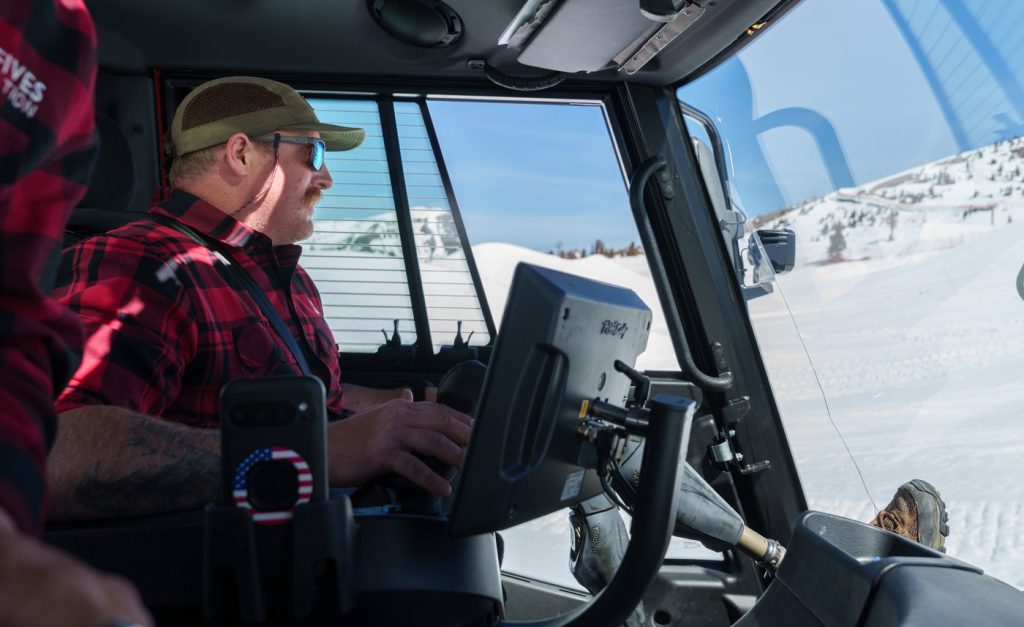
BANFF — It’s a blue bird day at Banff’s Sunshine Village and Canmore’s Erin Brown can’t wipe a smile off her face as she hops into the driver’s seat of a heavy-duty snowcat.
Adjusting to life after losing her right leg to sepsis three years ago, in the seat of the snow groomer that can be operated using hand controls, there’s nothing holding her back.
“This sounds silly, but I guess when I woke up, the first two things I asked is, ‘will I ever ski again and will I ever get in a boat again?’” Brown said, recalling the moments after coming out of a 10-day coma post-operation.
Face to face with her injury, everyday tasks seemed to have a question mark beside them, but three years out and she’s back ripping on skis, boating and is now adding snowcat operator to the list.
Brown is one of four participants to take part in the first PistenBully North America Adaptive Operator Camp that gives amputees and wheelchair users an opportunity to pursue a career as snowcat operators.
“The best thing about the snowcats is for the most part, they don’t require a ton of adaptations,” said Tyler Turner, Paralympic snowboarder and one of the camp’s organizers.
“I was a cat operator before my accident and I knew when I was laying in a hospital bed with no legs that I was going to be fine because I’d still be able to operate snowcats because there’s not really a need for feet,” Turner added, recalling his skydiving accident in 2017 that left him a double leg amputee.
Running May 11-12 at Sunshine Village, the initiative is uncharted territory for the ski industry, says Turner.
“I can’t believe no one has thought of this before,” he said, noting there were 40 applications for the course.
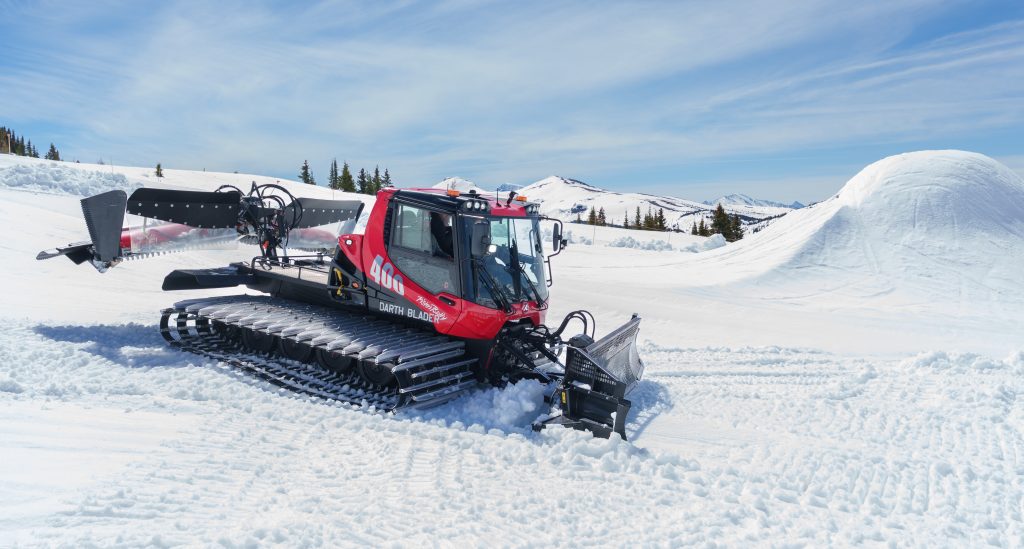
The idea turned to action when Turner teamed up with snow groomer manufacturer PistenBully and U.S.-based adaptive sports organization High Fives Foundation, holding a demo day in Reno, Nevada, to put their vision to the test.
“We tried to bring a lot of different folks with different disabilities to test what ability level would be necessary,” said Turner. “To see my friend Landon, a quadriplegic, operating a snowcat with little arm function driving around with the biggest smile on his dang face, it was one of the coolest things.”
“It proved the concept in spades. We knew we were onto something.”
Several months later, the first official operators camp at Sunshine Village ski resort was underway as Turner selected four applicants, all with a connection to the ski and snowboard world, to learn the ropes of operating and maintaining the grooming machines.
“Unfortunately, the path to getting into a snowcat is generally through working on trail crew, patrol – you’re out on the resort earning your stripes before you’re given the opportunity to run a half-million-dollar machine,” said Turner. “Unfortunately, with people in wheelchairs and amputees, that’s not an option.”
Over the course of two days, the team, with varying levels of ability, learned the day-to-day tasks of an operator from performing safety checks, controlling the blade and getting in and out of the machines.
“It was very nerve-wracking at first, but I truly believe fear and excitement are the exact same emotion. It’s just how you look at them. It was pretty quick, that I was pretty excited,” Brown said, describing the feeling of hopping in a cat for the first time.
“We’re seeing a massive boost in confidence and pride,” added Turner. “That’s really all I do things for, is to put a smile on their face. I think joy is probably one of the greatest healers that we have. It’s better than drugs. It’s better than anything … and driving snowcats is a lot of fun.”
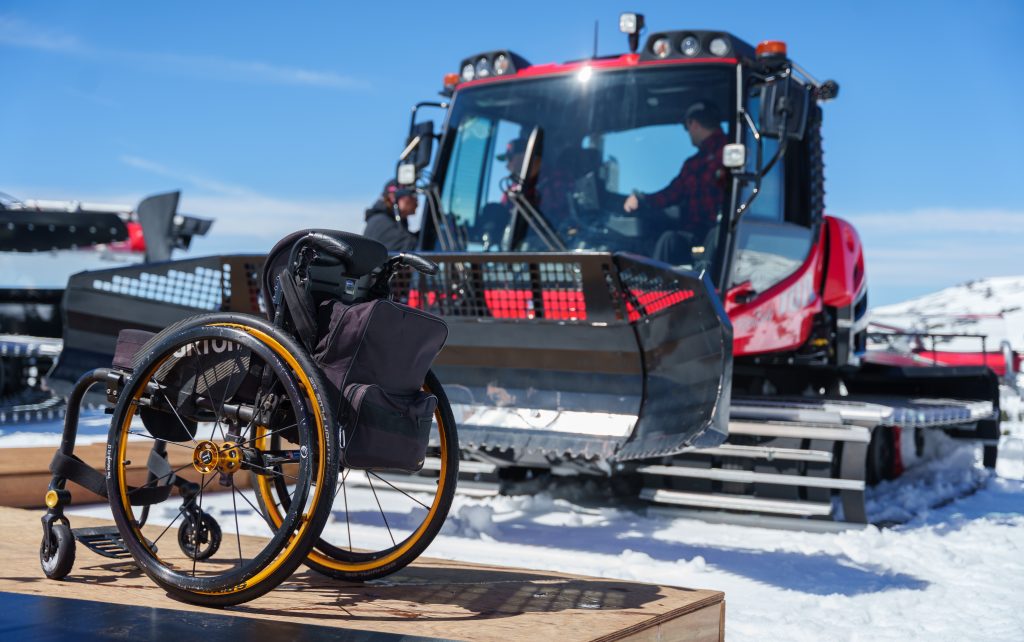
‘Back to normal life’
Turner knows what it’s like to wake up in a hospital bed with a life that looks totally different than it did yesterday. With that, comes a whole lot of questions.
“[People] are saying, ‘look, I don’t know what to do for work now,’” he said, recalling many applicant’s stories.
“I was a mountain biker, I was a skier, a snowboarder, I was a wakeboarder, I was an adventure seeker … whatever it may be, and I’ve lost the ability to be in the mountains or I’ve lost that community.”
Even more than an avenue to getting back to the mountains, Turner wants the camp to be a path “back to normal life.”
“Being fulfilled by the work that you do … is something that after a traumatic injury a lot of people don’t get to find again,” he said.
“Now you don’t have a job, you’re not very employable and your cost of living, if you want to live a normal life, goes through the roof,” Turner added, noting his prosthetics total $60,000.
Travelling from Sun Valley, Idaho, for the course, Matthew Krumwiede knows what it’s like to have to reevaluate the direction of his life.
“I grew up in Boy Scouts, snowboarding, being outside a lot and so no longer having that opportunity, or at least trying to do things differently, certainly shakes your world a little bit,” said Krumwiede, who lost both his legs and suffered damage to his left arm and hand after stepping on an IED while serving in Afghanistan in 2012.
“This is an amazing opportunity and it’s a unique one, it’s certainly not a common thing you see in this industry and so hopefully it continues in the years to come and gets bigger and bigger,” he added, noting he now works as a ski instructor and coordinator with an adaptive sports organization.
“I think as we continue on, I hope that this camp can provide insight to resorts that are looking to hire someone with a disability,” Turner said, adding the plan is to support participants beyond the camp, setting them up with references and connections in the industry.
After two days of seeing what’s possible from the cab of a snowcat, there’s no doubt the camp was a success, says Turner, adding that he hopes to build on what’s been started and eventually take the camp “on the road.”
“There’s a lot of growth happening here, and if it’s not just within the snowcat, I hope it’s just in lives and who knows where people are going to go with it after, but from hearing the conversations, there’s a lot of motivated folks leaving this course.”
The Local Journalism Initiative is funded by the Government of Canada. This position covers Îyârhe (Stoney) Nakoda First Nation and Kananaskis Country.
By Leah Pelletier, Local Journalism Initiative Reporter
Original Published on May 25, 2026 at 16:53

Recent Comments