
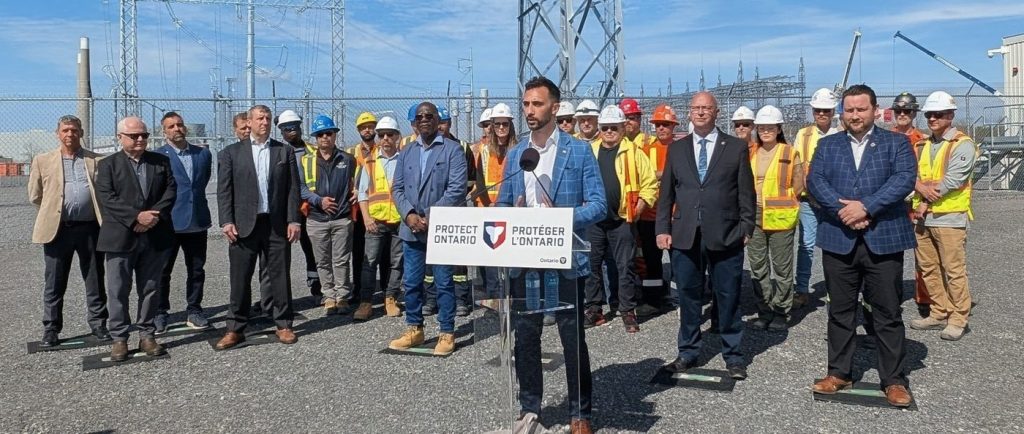
Ontario Minister of Energy and Mines Stephen Lecce travelled to Greater Napanee on Tuesday, May 19, 2026, to celebrate the completion and commercial launch of one of Canada’s largest battery energy storage facilities, describing the project as proof that Ontario can rapidly build major energy infrastructure “on time and on budget.”
Standing at the newly operational Napanee Battery Energy Storage System (BESS), Lecce framed the project as part of Ontario’s broader push to expand electricity generation and storage capacity, amid forecasts that provincial electricity demand could rise by as much as 90 per cent by 2050.
“We need more power in this province,” Lecce said during the press conference. “How do we secure clean, affordable, reliable power for future generations?”
The Napanee BESS project, a joint venture between Atura Power and Ameresco Canada, was selected through the Independent Electricity System Operator’s (IESO’s) Expedited Long-Term 1 (E-LT1) competitive procurement process launched in 2022. The facility sits beside the Lennox Generating Station on Ontario Power Generation-owned land along the Lake Ontario shoreline in Greater Napanee.
According to the province, the $600 million facility can power approximately 250,000 homes for up to four hours during peak demand, making it one of the largest operating battery storage projects in Canada.
The site includes 284 battery storage units, transformer stations, transmission connection infrastructure, and supporting systems designed to store electricity generated during periods of low demand — particularly from Ontario’s nuclear fleet — and return it to the grid when demand rises.
Lecce repeatedly emphasized that the project was completed approximately five weeks ahead of schedule while remaining on budget, presenting it as a model for Ontario’s future energy buildout.
“This project represents $600 million of value,” Lecce said. “A project that was delivered on time — in fact, slightly ahead of schedule — and even on budget.”
Throughout the event, provincial officials tied the project to broader themes of economic resilience, energy independence, and “made-in-Canada” infrastructure investment amid ongoing economic uncertainty and trade tensions with the United States. The province noted the project used Ontario-based suppliers, including 72 medium-voltage transformers manufactured in London, Ont., and purchased through an Indigenous-owned business operating in Nipissing First Nation.
Local officials and business leaders also framed the project as a major economic development tool for Greater Napanee and Eastern Ontario.
Greater Napanee Mayor Terry Richardson said reliable energy infrastructure is becoming increasingly important as the municipality continues attracting industrial and residential growth.
“Investments like the Napanee Battery Energy Storage System we are announcing today will guarantee reliable power and continue to make Greater Napanee viable,” Richardson said.
Ric Bresee, Member of Provincial Parliament (MPP) for Hastings—Lennox and Addington, described the project as critical to ensuring a stable electricity supply while positioning Eastern Ontario for continued industrial and economic growth.
The province said development and construction of the project supported approximately 120 jobs in engineering, skilled trades, transportation, and manufacturing, while the completed facility will support several ongoing operational positions.
But while much of Tuesday’s announcement focused on affordability, reliability, and economic opportunity, questions during the press conference turned toward emergency preparedness and public accountability surrounding large-scale lithium-ion battery storage systems.
When asked by Kingstonist what province-wide standards or funding supports exist for municipalities hosting battery storage facilities in the event of a major lithium-ion battery fire or other emergency, Lecce defended the project’s safety measures but did not directly answer who would ultimately bear operational responsibility in a serious emergency.
“There are clear protocols in place to [ensure] the safety not just of the actual assets, but of the community at large,” Lecce said, adding that local fire departments and emergency services are involved in training and planning processes.
Lecce then broadened the discussion to energy storage technologies more generally, saying the province is “agnostic” about which systems are used so long as they remain affordable, safe, and reliable.
When pressed further on who specifically would be responsible during a major incident — and whether municipalities receive additional provincial support for emergency response capacity — Lecce again emphasized training, protocols, and community engagement, but stopped short of outlining a clear chain of responsibility.
Atura President and Chief Executive Officer (CEO) Tom Patterson added that the company has worked closely with local emergency responders and that the facility includes onsite fire suppression systems alongside what the company described as “best in class technology” designed to reduce fire risk.
Tuesday’s exchange highlighted an issue that has surfaced repeatedly in public discussions surrounding battery storage projects in Greater Napanee and elsewhere: while governments and developers increasingly describe battery storage as essential infrastructure for Ontario’s energy future, questions remain about municipal emergency preparedness, long-term liability, and who ultimately carries responsibility if a major incident were to occur.
Concerns about emergency response and environmental risk surrounding lithium-ion battery storage systems have increasingly surfaced internationally as large scale battery projects expand. A recent review published through the National Fire Protection Association — a major fire safety standards organization whose codes are widely used across North America — noted ongoing gaps in understanding the full environmental and public health impacts of large battery fires, particularly regarding air quality, water contamination, and toxic metal emissions.
The Tuesday announcement concerned the completion of the existing Napanee BESS project approved under Ontario’s earlier E-LT1 procurement stream. The province separately confirmed that results from the next phase of Ontario’s long-term electricity procurement process — the LT2 capacity stream, which could include additional storage projects — are expected later this summer.
Kingstonist has also reached out to Greater Napanee Fire Chief Shawn Armstrong with additional questions regarding emergency preparedness and response protocols related to the facility.
By Michelle Dorey Forestell, Local Journalism Initiative Reporter
Original Published on May 20, 2026 at 08:38

Recent Comments